How to Architect Multi-Cloud CI/CD Across AWS, Azure, and GCP in 2026
A practical blueprint for one promotion path across three hyperscalers—signed artefacts, Terraform landing zones, and audit-ready GitOps that Australian platform teams can actually operate.
Why multi-cloud CI/CD is an architecture problem, not a tooling problem
Enterprises running AWS, Azure, and GCP simultaneously face a familiar trap: three independent pipeline factories, three secret stores, and three definitions of 'production ready.' The result is not resilience—it is operational debt that compounds with every acquisition and every regional expansion.
Standardise artefact promotion, not pipeline syntax
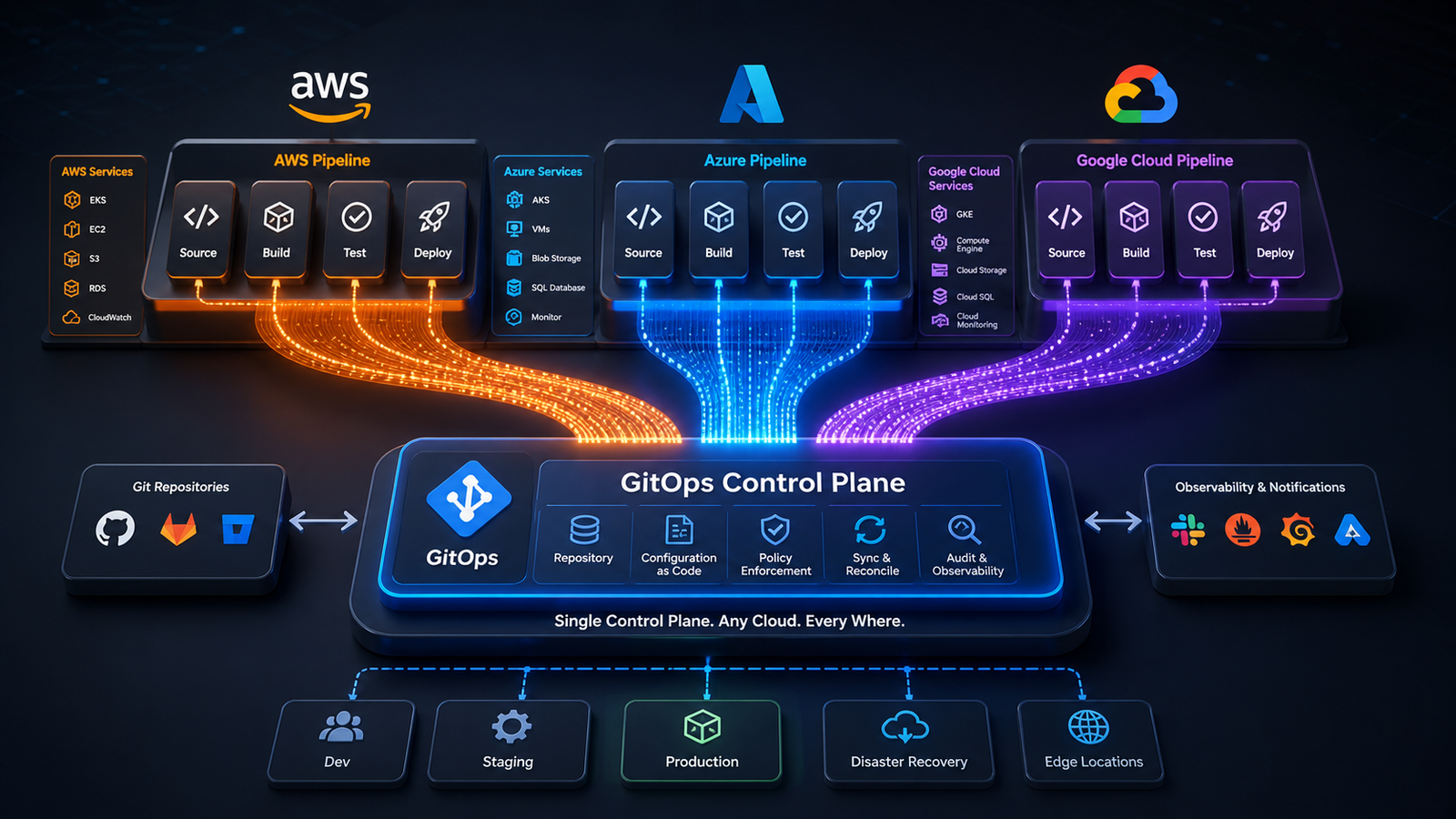
We recommend build-once, promote-many patterns: container images and infrastructure bundles are signed at build time and promoted through environment gates on each cloud. Azure DevOps, GitHub Actions, and Cloud Build can all emit the same artefact manifest format so auditors see one promotion trail.
Terraform and GitOps as the shared control plane
Landing zones on each hyperscaler are expressed in Terraform modules with consistent naming, tagging, and policy-as-code. Argo CD or Flux reconciles cluster state from the same Git repository regardless of whether the cluster is EKS, AKS, or GKE.
Cross-cloud observability closes the feedback loop
Deployment frequency and change failure rate must be measured per service, not per cloud console. Unified dashboards—fed by OpenTelemetry, Azure Monitor, and CloudWatch—let platform teams spot which promotion path is leaking defects before the next board review.
Australian compliance considerations
For APRA-regulated workloads, data residency and encryption boundaries are enforced at the pipeline layer: environment gates block promotion when classification tags are missing, and SBOM attestations are attached to every release artefact.